

Building No 10 North
A plan to ensure that this is something more than a slice of Whitehall with a Manchester postcode

“We will take power back from Westminster and Whitehall and give it to the place where you live”. That was Andy Burnham’s promise on inheriting the Labour crown. We already know he intends to fulfil this promise, at least in part, via the creation of a ‘Number 10 North’.

The pressing question now is: how?
Our new PM wants this new institution to be the “nerve centre of a rewired Britain”, and the driving force behind the mission-like objectives that he has begun to set out. Reindustrialisation, radical devolution, public ownership of utilities, local regeneration, and a shift in the culture and practices of Whitehall: each of these is a tall order for the three years that this Parliament has left on its clock.
It is perhaps telling that the new Prime Minister thinks his only chance of making progress is to establish something that stands outside the literal geography of Whitehall – and therefore may offer an opportunity to escape from some of its most challenging pathologies, too.
But there are many ways in which No 10 North might fail, or fail to live up to its promise. Given the level of ambition, even the establishment of a relatively successful out-of-London ‘hub’ for central government would be a failure of this idea on its own terms. Already, this is a concept that is being criticised for its potential costs and logistical implications.
To make this worthwhile, No 10 North must be more than symbolism, and more than an outpost of a centralised machine. It should be a testbed for a radically different approach to governance, a way of coordinating and shifting the wider civil service machine – the part of the Whitehall system that so transforms the relationship with subnational government that the ultimate measure of its success will be that most of its functions cease to be needed.
What No 10 North cannot be
Symbolism alone.
This is an idea that could fail without ever looking like a failure. No 10 North could become a hive of activity, with a beautiful new office space (when it is eventually finished in 2032, anyway), convening mayors, publishing strategies, running a full diary of ministerial visits. In other words, activity without impact: if this is all it is, the project would have failed – nothing important would have changed. Simply ‘making’ policy in Manchester is not sufficient to make the machine feel close to someone in Clacton, Camborne, or Carlisle. And if the overall result gives the spin of new approaches but does not actually expand the operational capacity immediately surrounding the Prime Minister, then an opportunity to address the lack of institutional heft that No 10 in London suffers from will have been missed.
Too small.
This is a lesson, in part, from the Darlington Economic Campus. The value of that government hub emerged when it achieved a certain critical mass, deliberately using the new location to break down the boundaries between different teams. Alongside the benefits of being able to recruit a more diverse group of people to government roles and a positive impact on the local economy, Treasury insiders believe Darlington has been a success. If No 10 North is ultimately about the relocation of a relatively small number of officials, it will always feel like a poor cousin to the ‘real’ Whitehall in London.
Business as usual.
If No 10 North is to add value, then it must be used as an opportunity to disrupt the usual norms and cultures of central government. Otherwise, the result will be a ‘regional office’ with the same, much criticised, Whitehall culture. Pursuing a new model will not happen automatically by dint of relocation: physical distance does not automatically create institutional difference. And the relationship with other parts of England’s governance – the Strategic Authorities that are set to be the centre of gravity for Burnham’s expansive devolution plans – will not automatically be transformed either. This will hinge upon design decisions.
A road to larger and more complex central government.
One of the primary benefits of a deep devolution agenda is that, eventually, it can give rise to a more streamlined and strategic central machine. When Whitehall no longer man-marks or micromanages local systems, swathes of its workload should disappear. Civil servants and national decisionmakers can refocus on genuinely national or international concerns. There may be an inevitable phase where No 10 North sees the expansion of the government machine as it is established, of course. But the devolution drive that it takes responsibility for, and the functions that it draws together, should mean that the No 10 North model helps to establish a more focused Whitehall system. If it is not designed with this in mind, it will instead spend much of its time coordinating sign-off across departments, consulting with relevant agencies, escalating issues back-and-forth with London – an institution designed to break down Whitehall silos would become another silo itself.
Replication of work going on elsewhere.
No 10 North should primarily be the product of bringing together existing capabilities in a productive new way, and building up new capacity and capabilities where these have not existed before. Simply reproducing or mirroring efforts playing out elsewhere in the system would be a failure, meaning this new part of the system will have had few opportunities to add value. Key programmes connected with the core, devolutionary purpose of No 10 North should be moved there.
A substitute for wider Whitehall reform.
No 10 North cannot be a panacea for every difficulty within the Whitehall system. It may develop approaches or help to rebalance that system in helpful ways, and by promoting fundamental devolution could help to bring about a much more effective central machine. But nothing in this plan reduces how urgent it is that answers are developed to long-standing structural, cultural, and procedural questions faced by that system.
A structure for No 10 North
The blueprint for No 10 North should be defined by the new priorities Burnham’s government wants to drive forward: raising living standards, devolving power, promoting public control of utilities, ‘reindustrialisation’, and regenerating places.
So that these goals do not go the way of missions (a term which is hardly used any more in Whitehall), the wider mission statement of No 10 North should be clearly expressed, and widely visible:
No 10 North exists to strengthen the executive core of Government as it pursues an agenda of spreading power, resources, and decisions to subnational governments and economies.
Delivering on this mission necessitates the creation of a simple structure, built around four core units and a dynamic Transformation Directorate.
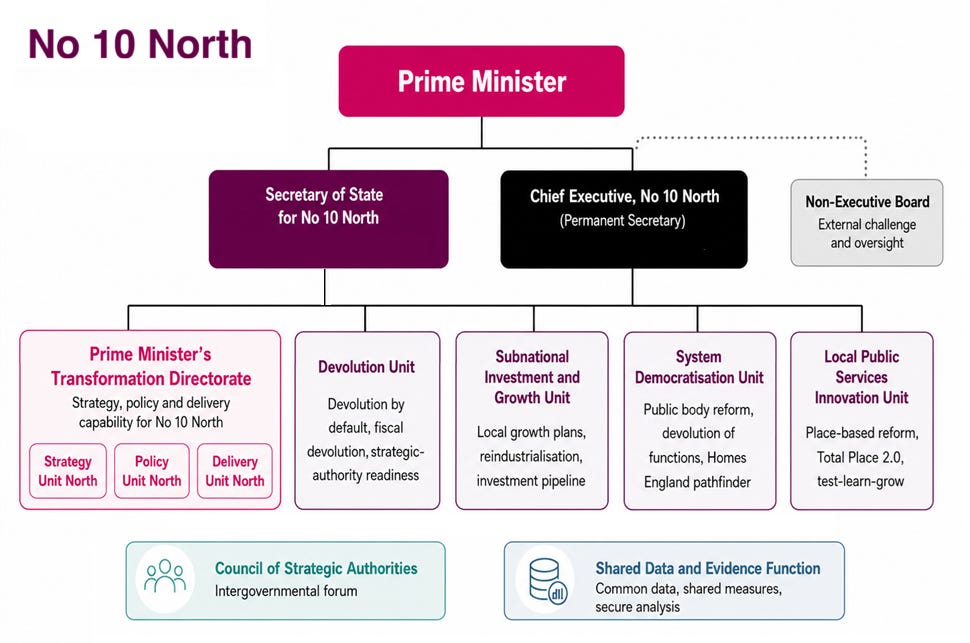
Four core units
The underlying objectives of No 10 North should be explicit from day one, and explicitly connected with the overriding mission of handing power to subnational government. Within No 10 North, a dedicated team should be created to pursue each of these objectives. These units may be geographically distributed where needed, but their main hub should be within No 10 North. They may also have seconded or connected participants who are directly employed by other relevant departments.
- The Devolution Unit
Drives forward the devolution agenda- The Subnational Investment and Growth Unit
Supports and facilitates local growth and reindustrialisation- The System Democratisation Unit
Reviews functions held by arms-length bodies for regional control- The Local Public Services Innovation Unit
Creates the conditions for place-based public service reform
The four units should provide No 10 North’s permanent institutional capabilities, rather than operate as four freestanding missions. Burnham’s priorities should be pursued through time-limited teams drawing personnel and authority from across the units and the Transformation Directorate. A council-housebuilding programme, for example, would combine the State Democratisation Unit’s work on Homes England, the Investment and Growth Unit’s work on land and finance, and the Devolution Unit’s work on powers and accountability. Reform of utilities would similarly cut across investment, devolution and the democratisation of national bodies.
The Devolution Unit
Function: The Devolution Unit will hold primary responsibility for coordinating a programme of devolution-by-default, including fiscal devolution, which will transform the wider Whitehall machine.
Operation: The office should require government departments to produce annual Devolution Assessments, setting out which of their functions were directly assessed or re-assessed, which aspects of these functions could plausibly be considered for devolution, which are to remain centrally-held, the evidence underpinning those assessments, and implementation timetables if any changes are proposed.
To operate these assessments, the Devolution Unit should develop and deploy a diagnostic framework for determining what aspects of a given policy or existing responsibility would best be devolved out of Whitehall. In Devolve by default Re:State provided a framework for doing exactly this.
Driving this approach will also depend on institutional maturity and a degree of consistency in local systems beyond that which currently exists in every place. The current devolution framework provides a footing for a more consistent and established system of strategic authorities, but notably does not contain the means to require places to adopt subregional structures nation-wide. Brokering the establishment of regional and subregional systems, on sensible geographies, should therefore become a primary objective of the Devolution Unit in No 10 North.
This specialist capability should see No 10 North taking default responsibility for responding to “right to request” submissions for further devolution of powers emanating from Strategic Authorities under the terms of the English Devolution and Community Empowerment Act (EDCEA).
The Unit should, alongside the Treasury and in close collaboration with the Investment and Growth Unit, pursue an ambitious fiscal devolution programme, with the principle initial aim of replacing the ‘integrated settlement’ within established mayoral strategic authorities with a scheme where 2.5p of locally raised income tax is retained by the strategic authority. This would establish a powerful growth incentive. Without fiscal autonomy, the centre can continue controlling the behaviour of places through grants, approvals and business cases even after formal powers have been transferred.
Finally, the Devolution Unit should take responsibility for encouraging the use of larger-scale operational ‘footprints’ in order to take on certain devolved responsibilities. It should do this by initially establishing firm pan-regional geographies within which collaboration on e.g. transport planning, economic development, and key service integration would be required. The Unit would create the incentives, legal routes and capacity that allow larger systems to emerge from cooperation between existing strategic authorities and local authorities. This would not complicate the subnational picture but enable a more consistent level of capacity and capability throughout England, and is the only route to devolving responsibilities from departments that require greater scale.
How to build it: To construct this Unit, specialist team members should be transferred from the Ministry of Housing, Communities and Local Government (MHCLG) (e.g. large parts of the existing Devolution and Local Growth Directorate, particularly the teams working directly on devolution frameworks and processing of right-to-request submissions under the EDCEA) and the Treasury (e.g. the teams working directly on drawing up plans for a fiscal devolution roadmap). Mutual secondments or ‘placed’ officials within both departments with reporting responsibilities to the Devolution Unit should also be considered. There should also be a porous interchange of officers from established strategic authorities.
The Subnational Investment and Growth Unit
Function: This Unit would lead No 10 North’s work on reindustrialisation and “good growth in every postcode”, translating national economic strategy into investable programmes rooted in the priorities of particular regional economies. It would not write new economic strategies for regions or substitute its judgement for that of strategic authorities. Instead, it would work from places’ ten-year Local Growth Plans, assembling the national support needed to deliver them and identifying opportunities for collaboration across regional boundaries. Its remit would span the productive economy and the conditions that make investment sustainable: industrial clusters and supply chains, business investment, infrastructure, innovation, skills, energy, connectivity, town-centre renewal and the wider quality of place.
The Unit’s central task would be to establish a coordinating and incentive-shaping role so that these levers are treated as parts of a single growth system, rather than as separate departmental programmes. This would reflect existing commitment to align the Industrial Strategy with place-owned growth plans, while giving that commitment a stronger centre of coordination and delivery.
Operation: In operation, the Unit would maintain a single national pipeline of strategically important, place-led investment projects and convene time-limited teams around those capable of transforming regional economies, collaborating closely with the Devolution Unit. These teams would bring together the relevant strategic authority, departments, public financial institutions and private investors to solve problems, with a formal link into the existing national investment infrastructure, e.g. the National Wealth Fund, to facilitate the work.
The Unit would oversee regional investment roundtables, align spending-review and industrial-strategy decisions with agreed place priorities, and escalate unresolved blockages where needed.
How to build it: The Unit would be built around a permanent core drawn principally from the Department for Business and Trade’s (DBT) Industrial Strategy Group and Office for Investment. DBT’s Industrial Strategy teams would bring responsibility for sector plans, supply-chain development and the business environment, while the Office for Investment would contribute investor engagement, project development and the ability to turn regional propositions into credible packages for private capital. From MHCLG, some capacity should be drawn from the Local Government, Growth and Communities Group. From HM Treasury, an embedded team from the Growth and Productivity Group, including its Infrastructure and Growth functions, should connect regional programmes to fiscal strategy, spending decisions, business cases and public investment.
The System Democratisation Unit
Function: One crucial role for No 10 North will be accelerating current attempts to reduce dependence on Arms-Length Bodies (ALBs), or quangos, within Whitehall – and playing the part of proactively identifying specific roles and responsibilities within this ‘quangocracy’ and supporting the process of their devolution.
This Unit, strengthened by its geographical remove from Whitehall, will take responsibility for that work, drawing together parallel efforts currently underway in different parts of the system, and with an explicit goal of identifying aspects of ALB delivery which would better be devolved.
Operation: This would be a systematic programme to rebuild, through the control of local systems, democratic accountability and control around functions currently exercised through ALBs, replacing the existing presumption in favour of organisational independence with a clearer test of where each public function should sit. It would examine whether decisions involving public money, service priorities, land and investment genuinely require insulation from elected government, or whether they should instead be returned to departments or transferred to strategic authorities and local government.
As set out in Quangocracy: the future of public bodies, there is a wider need to systematically review ALBs in order to distinguish functions requiring political impartiality or demonstrable operational independence from those placed at arm’s length merely because they are technical, complex or delivery-focused. This Unit would take on this role specifically for those functions that plausibly could be devolved, publishing a State Decentralisation Ledger recording candidate bodies and functions for subnational integration, abolition and devolution, or closer partnership with strategic authorities.
Homes England should provide the Unit’s proof-of-concept reorganisation effort, directly connected to the Burnham administration’s proposed council-housebuilding and regeneration drive. Following the model set out in New House Rules, the Unit should break the agency down function by function: transferring its affordable-housing funding and place partnerships, land activities and approximately 9,000-hectare portfolio, and much of its technical delivery capability to strategic authorities as their readiness develops, with appropriate double devolution to constituent councils. Functions that still require national scale, such as specified financial or legacy responsibilities, would be placed in a clearly accountable central institution rather than used to justify the continued existence of the whole agency. The process would move staff, budgets, data, assets and accountability, while strengthening regional capability during the transition. This will be essential for achieving a signature promise of the new Prime Minister, and reflect that a new generation of council houses will not be delivered through central management.
How to build it: This Unit would be primarily staffed by officials transferred from teams tasked with public bodies reform and classification within the Cabinet Office.
The Local Public Services Innovation Unit
Function: Public services must be reformed in order to achieve the objectives of improved living standards and transformation of the State outlined by Burnham. Much of that reform should play out at a place-based level, and the interaction point between the local scale of change and innovation and the need for central facilitation, learning, and coordination would be a natural fit for No 10 North.
The Public Services Innovation Unit would create the conditions for places to redesign public services around people, communities and outcomes rather than departmental boundaries, even as local powers grow through devolution.
Operation: The Unit’s most important function would be to turn individual experiments into a continuous learning system for the State. It would maintain a portfolio of place-based reform partnerships, deploy mixed teams of local practitioners, service designers, analysts and departmental officials, and use rapid testing and real-time evaluation to improve services while they are operating. It would then identify which lessons are locally specific, which principles can be adopted elsewhere, and which central rules must change, feeding evidence directly into spending reviews, departmental policy, professional standards and regulatory frameworks.
Prior to the wide establishment of fiscal devolution, this Unit would provide the central-government backdrop for a successor to ‘Total Place’, enabling strategic authorities, councils, the NHS, police and other local partners to pool or align their service geographies, budgets, data, workforces and accountability around defined populations or problems.
How to build it: The operating core of the Unit should be formed from the Cabinet Office’s existing Test, Learn and Grow programme – which would move to No 10 North – bringing its accelerator teams, central reform work and place-based learning network into a more permanent institutional home. It should be joined by capacity from MHCLG’s Local Government, Growth and Communities Group, particularly the teams responsible for public-service reform, strategic-authority relationships, integrated settlements and local-government finance, and by embedded Treasury officials covering public spending, public-service productivity, local growth and place-based budgeting.
Other departments would partner according to the problem being addressed: the Department for Health and Social Care and NHS England on neighbourhood health and prevention; the Department for Education on SEND and family support; the Department for Work and Pensions on employment and economic inactivity; and the Home Office and Ministry of Justice on vulnerability, offending and community safety.
The aim would be to replace the current collection of separate place programmes and bilateral departmental relationships with a single route through which local systems can obtain a coordinated response from central government. These time-limited teams should also draw in, through secondment arrangements, team members with relevant academic expertise, individuals in civil society organisations, and business leaders.
The Prime Minister’s Transformation Directorate
As the central coordinating ‘engine’ for what No 10 North is aiming to achieve, it should include mission-focused ‘north wings’ of a Strategy Unit, a Policy Unit, and a Delivery Unit – all comprised of a mix of officials and appropriately staffed with Special Advisers.
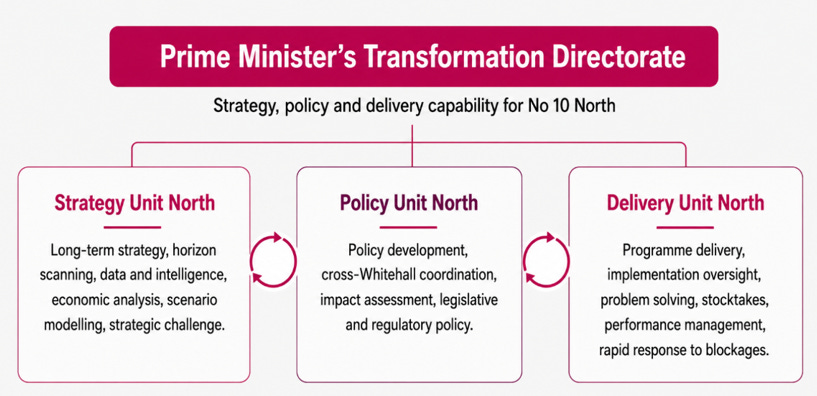
This would strengthen the executive core in three areas where successive governments have been weak: developing and sustaining long-term strategy; converting political ambitions into coherent, cross-government policy; and maintaining grip on implementation once announcements have been made. This would give the Prime Minister dedicated capacity to understand how the State is functioning across different places when looking at the specific focus areas of No 10 North, identify where departmental structures or national rules are preventing progress, and intervene on the small number of priorities that require authority from the very centre of government, compensating for a long-term decline in the strategic capacity of government.
The Strategy Unit, Policy Unit, and Delivery Unit should not operate as three conventional teams passing work sequentially between them. Each of No 10 North’s major programmes should instead be supported by a multidisciplinary transformation team from the outset. Strategy specialists, working closely with special advisors, would establish the long-term objective, understand the wider system and test alternative routes to change. Policy specialists, supported by standing reference and advisory groups of external experts, would translate that direction into choices about powers, institutions, finance, legislation and accountability. Delivery specialists would establish milestones, gather intelligence from places, identify constraints and organise rapid intervention where progress is stalling. This should mitigate the established Whitehall pattern where implementation is considered too late and where strategy, policy development and delivery management can become separate professional exercises rather than parts of a single process.
So, where the Policy Unit North’s imperative is creating and maintaining a core mission for No 10 North’s immediate agenda, Strategy Unit North is about thinking for the future. Meanwhile, Delivery Unit North works to enact the ideas of the former and approximate the vision of the latter.
The directorate would provide surge capacity, reinforcement and independent challenge to the four specialist units within No 10 North, and at times operate as a kind of internal consultancy to help solve problems as these units drive forward government’s core policy agenda. Overall, this structure should strengthen the hand of No 10 without creating the temptation of micromanaging questions or issues which should in fact be handled with a looser or more decentralised grip.
Intergovernmental machinery
The Starmer administration established various interface points between central and subnational government as part of its “devolution revolution” drive. The signature result was a Council of the Nations and Regions, drawing together key leadership of devolved entities in regular dialogue with the central State, and an England-focused Mayoral Council.
No 10 North would be a natural home for an evolution of this structure – a reference group and policy development function that would formalise the involvement of directly elected mayors in the core work of No 10 North’s four units and the delivery architecture of the transformation directorate.
A formal Council of Strategic Authorities, building upon the existing Mayoral Council, and chaired regularly by the Prime Minister or the cabinet minister responsible for No 10 North, should involve these entities directly in shaping the priorities pursued through its four core units and the programmes supported by the Transformation Directorate. The existing Council of the Nations and Regions should retain its distinct UK-wide and constitutional role, while the new body provides a more continuous working relationship with England’s devolved institutions. Strategic authority leaders and officers should participate in stocktakes, policy-development groups and relevant reviews of Whitehall and arm’s-length-body functions, ensuring that the intelligence and priorities of places enter the process before central decisions are formed.
This relationship should also confer clear procedural rights. Strategic authorities should be able to escalate barriers involving multiple departments or national agencies to No 10 North, triggering a single, time-limited response from central government rather than another sequence of bilateral negotiations. They should be able to propose packages of devolved powers, pan-regional arrangements and changes to national rules, with Whitehall required to explain publicly where these are rejected or delayed. Two-way secondments, shared data systems and mixed central-local delivery teams should make this a permanent working network rather than a succession of meetings.
From roadmap to reality
Operationalising No 10 North
Institutional features
- No 10 North, like No 10 Downing Street, should initially be instituted as a distinct grouping within the Cabinet Office. This will allow for speedy establishment and use of existing processes and legal and financial infrastructure.
- Its base of operations should be an existing secure government site located within Manchester. It may also be appropriate for some team members to negotiate shared office space in sites owned by Greater Manchester Combined Authority and Manchester City Council. In the medium term, a dedicated facility or campus should be opened.
- Immediate action should be taken to ensure that the selected site allows secure operations outside London, with top-secret communications links.
- No 10 North should be operated with its own independent budget, initially derived as a proportional reallocation from the budgets of the existing No 10 operation, the Cabinet Office, the Treasury, and MHCLG.
- The purpose or mission of No 10 North should be clarified in an open ‘charter letter’, setting out transparently what is expected from the new office.
- No 10 North should operate with a presumption of transparency about its objectives, decisions and institutional impact. It should produce its own Outcome Delivery Plan and publish alongside it an annual business plan setting out the responsibilities of each unit, the objectives being pursued, the powers and resources available, and the outcomes against which progress will be judged. It should then proactively publish its progress against those selected indicators every six months.
- No 10 North should have a shared data and evidence function serving parts of the organisation. Led by a Chief Data and Evidence Officer and collaborating closely with the Mayoral Data Council, it should agree data-sharing arrangements across government and with strategic authorities, develop common place-based measures, and enable secure analysis of linked administrative data. Its job would be to remove practical barriers to data sharing and give decision-makers a clearer view of how policies interact within particular places.
- A small, active board of non-executive directors should be established to provide another source of input and oversight. The importance of this No 10 North board should be reinforced in the PM’s initial charter letter. The board should be composed of very senior figures from across private sector, third sector, local government, and regional government. They should be chaired by a high-profile, independent outsider.
- With the exception of secretarial and Private Office functions to enable smooth logistical collaboration between Manchester and London, none of the functions or teams within No 10 London should be directly replicated in No 10 North.
Leadership and key appointments
- No 10 North should be led by a senior front bench politician at the level of a Secretary of State. The least disruptive approach would be to assign the role to an established Cabinet role, such as Chancellor of the Duchy of Lancaster or Deputy Prime Minister. This person should be supported through the appointment of a London-based Parliamentary Private Secretary.
- A junior ministerial post should also be created within No 10 North, taking on particular responsibility for the work of two of the ‘core units’ – the allocation to be decided according to the expertise within the new ministerial team. This may reduce or eliminate the need for one of the junior ministerial posts within MHCLG.
- The most senior official in No 10 North should be appointed at the level of Permanent Secretary, and be styled as the Chief Executive of No 10 North. This person should also directly manage the Transformation Directorate structure.
- Each of the four ‘core units’ in No 10 North should be led by an official at either Director General or Director level. These officials should report directly to the No 10 North Chief Executive.
- The heads of Strategy Unit North, Policy Unit North and Delivery Unit North should be recruited in a way that actively prioritises non-traditional backgrounds. Ideally, they would be led by established experts who are outsiders to the Whitehall system. Appointing each of these leads as a Special Adviser should therefore be considered. These appointments should bring strategic, institutional and operational experience into the centre from strategic authorities, local public services, business, academia and civil society, rather than reproducing established Whitehall career pathways in a new location. Each should be supported by a senior civil-service deputy able to navigate Cabinet, departmental, legislative and propriety processes. This model would combine external challenge and practical experience with the institutional fluency needed to turn ideas into government action.
The role of the Prime Minister
- The Prime Minister should follow through with his commitment to, in an ordinary week, work for at least one day from No 10 North.
- The Transformation Directorate should prepare a fortnightly PM’s briefing, to be presented to the Prime Minister and the No 10 North Secretary of State, detailing progress against the policy priorities within the organisation’s remit.
- No 10 North should also be home to a quarterly devolution update meeting, bringing together the Prime Minister, Chancellor, No 10 North leadership, Secretary of State for MHCLG, relevant other Cabinet members, and the members of the Council of Strategic Authorities.
Building the team
- The team of officials and experts working within No 10 North should be recruited through:
o transfers of relevant teams or individuals working elsewhere in central government;
o secondments from different departments, strategic authorities, and local government;
o external recruitment from across Greater Manchester and the wider North (more than 80 per cent of civil servants based at the Darlington Economic Campus were recruited locally).
- Almost all ‘new’ (non-transfer and non-secondment) appointments should be made through open and ‘plain English’ recruitment processes.
- Teams and units needed to staff the units proposed in this report have been indicated in the sections above.
- The largest single transfer would be the Devolution and Local Growth Directorate, which should be formally shifted via a Machinery of Government change into No 10 North for reorganisation across the new units. This would comprise roughly 100-120 staff, leaving in MHCLG some programme administration and legacy project management teams.
- During an initial “mobilisation phase”, lasting 12-18 months, higher levels of transitional hybrid working and remote participation should be allowed within teams as relocation of staff, formal transfers, and recruitment play out.
- No 10 North should aim to reach an initial critical mass of around 300 staff by the end of its mobilisation period, with further short-term personnel assembled around particular missions.
- After this initial phase, the proportion of locally based staff and overall office attendance expectations should be clearly established.
- If a specific Whitehall-based team is identified for transfer to Number 10 North, any team member not able to relocate to Manchester within the mobilisation phase should be transferred instead to a different team within the same department, or encouraged to apply for another London-based role in a different department. Staff unable to relocate should therefore be offered structured redeployment elsewhere in the Civil Service, with compulsory redundancy used only as a last resort under existing procedures.
The first nine weeks
Weeks 1-3
- Identify interim headquarters/negotiate incubating space; take logistical steps to
secure and resource
- Settle resourcing arrangements
- Appoint key leadership positions – Secretary of State, chief executive/permanent secretary, core team of special advisors
- Publish a founding charter letter, clarifying the objectives, remit, and approach
- Initiate an explicit “mobilisation period” and make initial approaches to teams most likely to be transferred
Weeks 4-6
- Further appointments, if only on an interim basis: senior leads and key
advisors for Strategy Unit North, Policy Unit North, and Delivery Unit North
- Engage relevant teams in Whitehall departments and begin to recruit transfers,
secondments, and key relationships to build capacity within the four core units
- Publish an anti-duplication plan, specifying clearly which existing Whitehall
teams will be earmarked to shift or shrink as a result of Number 10 North’s work
Weeks 7-9
- Arrange first new-style Council of Strategic Authorities meeting
- Task Devolution Unit with development of a full devolution diagnostic
framework for Whitehall
- Task State Democratisation Unit with a functional review of Homes England
A new opportunity
No 10 North can succeed only if it is designed from the start to be an exemplar of wider changes to how the State works.
It must strengthen the part of central government that immediately supports the Prime Minister, while systematically transferring power, money and responsibility outwards, and building a very different relationship with local and regional government around England.
To accomplish this, No 10 North must operate outside the existing Whitehall system to help inculcate changes designed to, over time, transform the whole operation.
Built well, it could become the machinery through which Whitehall finally learns to let go.
Phew. Not just a ruse for A.B. to do WFM then.