



It turns out we’re facing both a literal and a metaphorical El Nino in the coming months. And both will hit the British public hard.
The Chancellor chose to open his Budget speech warning that we face economic “storms” (rather than the usual “headwinds”). That could have been teeing up a set of radical reforms to address our sclerotic growth, get the public finances back on track and tackle the cost of living crisis. Instead he delivered a Budget dizzyingly heavy with measures, yet woefully light on impact. With ‘fiscal headroom’ down to £15 billion, our ability to weather the economic storm looks as good as our ability to weather the physical one – which is to say, very poor.
Over the course of the forecast, borrowing is up every year, growth is revised down significantly next year and never hits 2 per cent, and net debt is higher at the end than the beginning (but the fiscal rule is met because it rises even higher in between, proving, again, how ridiculous the rules are).
It is also worth noting that, again, the OBR is at great pains to tell us how uncertain their forecasts are. This is largely due to external factors, but it is worth noting that they still haven’t quantified the impact of the Employment Rights Act, though they do now say “it will likely have a negative impact on potential output”. In fact, they state that “negative impacts on businesses, particularly through increased uncertainty, lost flexibility and higher labour related costs…will more than offset any potential positive impact on worker productivity.”
Perhaps most dangerous for a Government promising “breathing space” for families struggling with the cost of living, the OBR forecast “no real earnings growth in 2027”, or indeed in 2028, after which Healey’s “working people” can expect to hit 0.5 per cent growth by 2030. Real Household Disposable Income (RHDI) per person will also fall next year, and be lower than forecast in March – by 2030-31 it will be just 2 per cent above pre-pandemic levels. You can see why people are speculating about an early election.
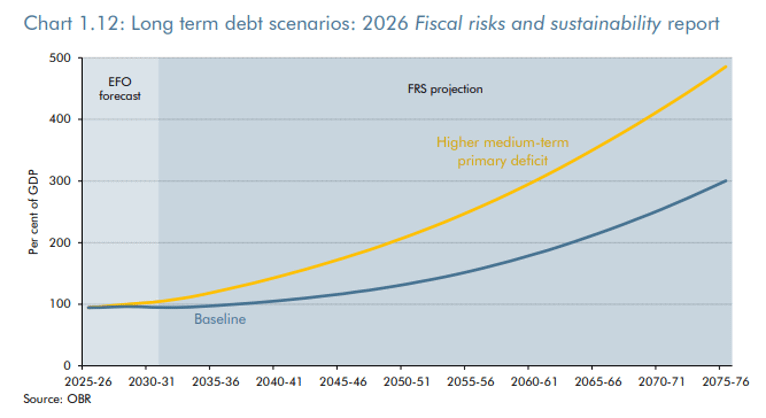
On public spending we’ll largely have to wait for the Spending Review (including the promised welfare reforms), but before you read on for our usual ‘good for’/’bad for’ snap analysis, I wanted to leave you with a graph. Rachel Reeves had met her fiscal rules in part by baking in fiscal consolidation during the later years of the Spending Review – few thought this was realistic. The same applies for Healey. Chart 1.12 from the OBR Outlook shows what will happen to debt if that consolidation does not take place – and as the OBR points out, history indicates it won’t (“since 2022, successive governments have set out similar plans for medium-term consolidation which have not subsequently been achieved”). Some day our political class is going to have to find a backbone and make some tough decisions. Today was not the day.
Read on for the team’s more detailed analysis of policies announced.
Charlie
Chief Executive
Good for 👍
Better regulation
The Budget makes some welcome moves on red tape. Bringing back the Better Regulation Executive, based in the Treasury and No10, puts weight behind the Government’s 25 per cent target. Up to £640 million a year of further savings in businesses’ administrative costs, from extending audit exemptions to medium-sized companies to simplifying home buying, show some action, as does accepting most of the Small Business Regulation Taskforce’s recommendations. A new MoD-led drone regulation unit and plans for regulatory sandboxes are welcome too, though the detail awaits the Regulating for Growth Bill, still unpublished six months after the King’s Speech.
Procurement reform
The Chancellor is right to use this Budget speech to try and harness the power of new technology for government, and get more start-ups and scale-ups involved in the public sector. He’s promised extra public financing, but that will only feed through into a more competitive market if companies can then sell to the State commercially, with a pipeline of contracts and a better shot of winning them. The Chancellor has committed to more challenge-based procurements like Sovereign AI’s R&D Procurement Scheme, in a welcome move to open the doors to new suppliers. But will they face less onerous requirements? The new National Procurement Policy Statement which he promises will come in 2027 is an opportunity to reduce burdens on suppliers, and he would do well to take on board measures in our own draft published last month.
Datacentres
In the AI age, the UK desperately needs improved grid connections and more data centres. The Data Centre Covenant and Ministerial Control Centre announced in today’s Budget, aimed at delivering swifter approval of well-connected data centres, are steps in the right direction. The Government needs to overcome the vocal but distracting objections to data centres, and the Covenant may be a way to do that — companies can afford to pay more, including for infrastructure and compensation for local communities, if in exchange permissions are sped up. In addition, the Covenant will require adherence to environmental standards, thereby addressing many of the concerns data centre critics cite.
Efficient public services
The Budget estimates central government efficiency savings of almost £600 million in 2029-30 and cuts departmental administration budgets by 20 per cent in real terms. This is a welcome part of the Government’s “rewiring of the State”. But what this means in practice is unclear. As the OBR notes in its analysis of the budget, the Government’s own accounting of the efficiency savings does not distinguish between cash-releasing and non-cash-releasing savings, and the latter are much harder to estimate and less helpful for the Treasury in managing the public finances — the devil will be in the detail.
Fiscal devolution
The Chancellor’s roadmap for fiscal devolution provides welcome clarity on the Government’s plans, and is one area where the rhetoric is not far off the reality. England has long been one of the most centralised countries in the world, especially when it comes to tax, so any transfer out of the centre is big news, and fiscal devolution which gives local government ‘skin in the game’ for pro-growth policies is welcome — although much still needs to be finalised.
Mayors will be integrated into the business rates retention system in a systematic way for the first time — receiving a 20 per cent share of their area’s business rates income from April 2027. The Government has committed to a model in which mayors and local authorities will between them retain 100 per cent of business rates by the end of the decade (at least 70 per cent of which will go to councils, for whom business rate revenue is a major source of funding). This will align mayoral and local authorities around local growth and create a more consistent system. But this doesn’t necessarily mean that an area will keep all of the growth in their business rates forever, the periodic resets, which at some stage redistribute away retained business rates growth to other areas, are set to continue.
And these initial moves towards a more localised model for business rates are somewhat at odds with the Government’s decision to raise the Small Business Rates Relief Threshold to £18,000 for qualifying properties — a welcome bit of respite for many small businesses, but one where a more fully devolved system of property taxation would instead allow places to vary thresholds and multipliers themselves, deciding on the right approach for their area.
The assignment of a portion of income tax to Mayoral Strategic Authorities – which is the big-ticket item confirmed in the roadmap (and one which Re:State has previously called for) — is a major change to the fiscal framework: giving financial certainty to these institutions and embedding them within the UK’s constitutional architecture. Some details are coming into focus — there will be an equalisation adjustment and a number of safeguards, for example. But key questions such as the actual amounts for each area are yet to be answered. Given this, the jury’s still out on the extent to which the new funding model will reward strong growth.
Bad for 👎
Pensioners doing their bit
Though billed as a Budget for “working people”, the Government is shielding pensioners from tax rises while fiscal drag pulls more and more low-paid workers above the income tax threshold. The Pension Tax Allowance is designed to accommodate the planned 3.9 per cent pension uplift in 2027, preventing pensioners whose income is at or just below the full new State Pension from becoming liable for income tax. The policy will cost £45 million in its first year, rising to £150 million by 2029-30. The planned triple lock adjustment, which will see a marginally less generous uprating, would be a welcome move towards (slightly) rebalancing spending, but scoring it from April 2030 is pointless — we’ll have had a general election before that, leaving the savings dependent on a policy that may never happen.
£100 (energy) bung
The centre piece of the Government’s cost-of-living ‘package’ was a £100 cash payment for all households in Council Tax Bands A-D (up to 20 million), costing a cool £2.6 billion. It’s not as bad as the Liz Truss £400 subsidy for everyone, but the targeting is not much better, meaning plenty of wealthier households will be needlessly receiving a state handout that we can ill afford. And for those households that are really struggling, it doesn’t come close to covering the predicted rise in energy costs — estimated by Cornwall Insight to be £276 from January 2027. Even adding the further £50 saved by the extension to the VAT cut, households are still seeing their bills jump. It’s hard to see how families are going to feel the promised “breathing space” when the measures on energy and food are only slowing the rate of price increases, and the OBR "expect no real earnings growth in 2027”
Spending classification
Many bad policies are made with good intentions, and the commitment to ringfence ‘preventative departmental spending’ (PDEL) in the next spending review is one of those. While it is intended to protect expenditure on “early intervention” from short-term budget pressures, this approach just doesn’t add up. As we have argued previously, what’s the workable definition of “preventative” spending — aren’t schools and GPs doing preventative work? — or “early intervention” — is that building more houses to prevent homelessness or spending more on programmes for rough sleepers? And if so much spending could be classed as preventative, won’t departments relabel existing budgets rather than spending more on prevention? Plus, isn’t the whole direction of travel for the Government unringfenced, devolved, place-based budgets, allowing areas to spend as they see fit?
Fiddling
For a Budget which barely moves the needle on the long-term state of the finances, the volume of measures is enormous – the policy costings table counts 98, ten more measures than Rachel Reeves’ (much fiscally larger) Budget last year. In every area — savings, investments, the cost of living and cost to business — the Government is promising a raft of small initiatives. But add them all up and they amount to very little. We already have one of the most complex tax codes in the world, and that complexity comes with real costs and distortions to what businesses and individuals choose to do — this Budget makes it worse.
Just get on with it 👉
Carer’s Allowance reform
The Budget includes a very welcome reform to Carer’s Allowance. At the moment, a carer who exceeds the Weekly Earnings Limit, even by a £1, loses their entire weekly Allowance — presenting an absurd disincentive to earn more (good for them, good for the economy). Instead, the Government will remove the cliff edge and withdraw £1 of Allowance for every £1 earned above the Limit. It doesn’t go nearly far enough, still keeping a fairly strong work disincentive, but it is a step in the right direction. Apart from the Government isn’t actually doing anything, as the reform isn’t set to come in until 2030–31 — after the next general election. At a cost of £120 million over two years, it’s a drop in the ocean of welfare spending, and represents a disappointing failure to just get on and do the right thing.
The test you set, that extra public financing only helps if companies can then sell to the State with a real pipeline of contracts, is the right one. Much of the useful signal for smaller suppliers sits in pipeline notices and preliminary market engagement, and many buyers still publish those late or not at all, so firms only find out when the tender has already been shaped around an incumbent. If the new policy statement asked departments to publish forward pipelines consistently, challenge based procurements would reach a much wider field.
Its difficult to criticize british fiscal policy knowing the true value of it lies not in the calculation but rather in the prediction of future events. 10% here 150 million there, these amounts mean much less to me as a reader than the question of “are all the players of the game theory enacting such as that expected?”