



Today, Re:State publishes ‘Beyond caring’, a major report setting out new proposals for sustainably funding later-life social care.
There is not one social contract, but dozens. There is the contract of care when we are sick; there is another for a time of war. There is the social contract for the raising and education of our children, and for the way that we influence local decisions in our neighbourhood.
Some of these social contracts are, if not broken, then… dissolved. First among those is the contract that exists between the State and older people who need care.
The current system was designed for a population and a time very different to ours, when the average person lived a shorter life and the many diseases associated with ageing were far more unusual. That system is already unsustainable; in the next few decades it will be altogether crushed by demand. Last year, public adult social care spending rose to £34.5 billion, up more than 4 per cent on the year before, and almost as much as the Home Office and Ministry of Justice budgets combined. There is little indication that growth in cost will slow any time soon.
Not a mystery
None of this is a mystery. The basic facts are not a matter of debate. We know that most people will need some kind of care in later life. We know that the current social care system is not doing its job and is not sustainable. We know that the ballooning costs of these services are driving local authorities to the point of effective bankruptcy. We have spent the best part of three decades commissioning reports, launching reviews and announcing fresh starts on social care. The Casey Commission, welcome as it is, is only the very latest attempt.
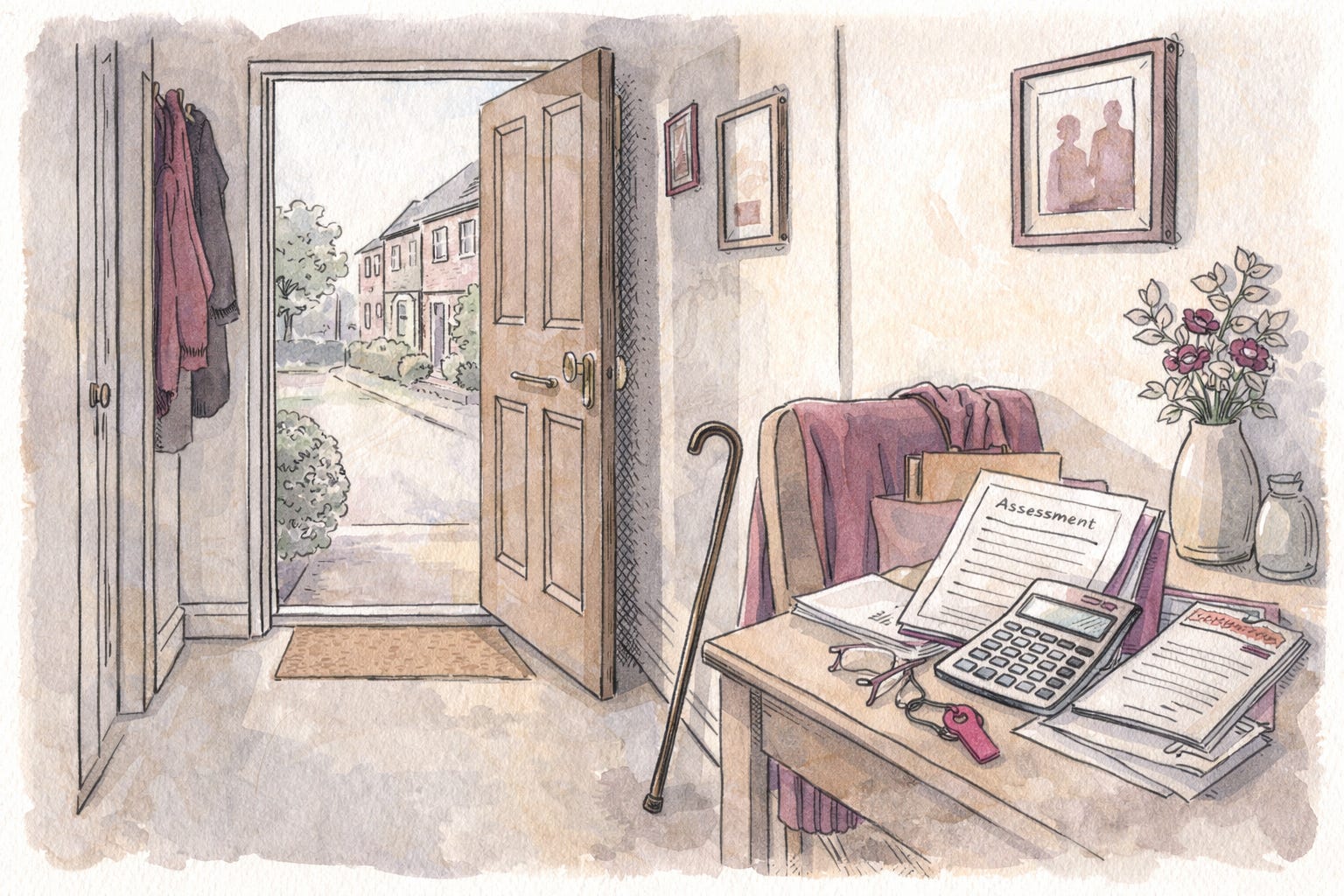
We also know that the individual experience of accessing these services can be incredibly challenging. First, a fall. Leading to a hospital stay that turns out not to be a brief interruption, but also the start of something more. Then comes the meeting, the folders. Needs assessments. Assessments of assets against thresholds, with different rules about what counts and what doesn’t based on the type of care needed.
This is the point at which many people discover that England does not really have a settled social contract for later-life care. It has a financial model that serves almost nobody well, and which fails to sustain even a patchwork of provision.
We presume that the State will be there. We live in a country where people simply expect healthcare to appear when serious need arises (though, let’s face it, that’s an expectation which has already broken down in the NHS). But social care is different. It is essential, and it is also heavily localised, poorly understood, and capable of generating bills so large and so erratic that normal financial planning might barely scratch the surface. The result is a system that feels insufficient, not only because it is under strain but because it so often violates what people thought the deal was going to be.
It is also a system where the challenges come out of nowhere for most people (and do so at the worst possible time): only 4 per cent of the public in March 2025 named social care, unprompted, as one of the most important issues facing the country, compared with 29% for the NHS. People just don’t think about needing care until they desperately do.
That gap between expectation and reality is one reason the politics of social care have been so difficult. Everyone agrees the current system is failing. Almost nobody feels confident that the next reform proposal will be either fair or durable. The policy-debate ‘consensus’ on Andrew Dilnot’s proposals, whatever their actual virtues, has failed to produce actual change to the system – most recently when the planned introduction of a costs cap was cancelled by the current Government as one of their first acts in office.
More than a crisis
Governments promise action, commission reviews, flirt with caps, retreat from backlash, and move on. Meanwhile, the underlying problem gets worse.
It is too easy to simply say that the social care system is ‘in crisis’. ‘Crisis’ implies a system that is experiencing sudden or unusual challenges. But the challenges here are long standing and systemic: they emerge from the design of the system itself, and its mismatch with the reality of the populations that it is supposed to serve.
The average person will need at least some care in their later life. We do not know whose needs will be brief and whose will stretch on; whose will be affordable and whose costly. We do know that some people will face very high costs, but that there is no plausible private insurance market to meet that need. In other words, this is exactly the sort of risk modern states are meant to pool.
Instead, providers of social care services for the elderly operate in a lopsided market. Younger taxpayers are asked to sustain a growing burden through a model that protects much of the wealth later-life of older generations, while still leaving many older people exposed. Attempts to make significant changes are liable to be seized upon as “dementia tax” and hastily abandoned.
A new plan
An unsustainable system, a collapsing social contract, and policy solutions that are deemed politically impracticable: these constitute the starting context for our new paper, Beyond caring.
As a first step, we argue that England should stop pretending that working-age adult social care and later-life social care are fundamentally the same policy problem. They involve different kinds of need, different questions of fairness, and different funding logics. For many working-age adults with severe disabilities or lifelong conditions, it is neither realistic nor morally coherent to imagine that they should somehow have insured themselves against their care needs. Later-life care is different. Some degree of need is common enough, and predictable enough in the aggregate, that a contributory system makes sense.
How then to build a sustainable system on that contributory basis? One that is fair – across ages, across geographies, across socio-economic groups.
In simple terms:
- The Government should establish a national Later Life Care Fund, pooling risk over the largest possible population – because this is a collective problem, driven by uneven levels of need.
- The Fund should not come from council tax precepts or cash diverted from general taxation, but from mandatory contributions (1.8 per cent) from the incomes of people over the age of 34, similar to social insurance systems in places like Germany and Japan.
- The Fund should be invested for growth so as to keep pace with likely above-inflation increases in the cost of care.
- When the time comes, the Fund should be used to fund the social care needs of the specific cohort that paid into it.
- For those who need basic or low levels of care, the Fund should always pick up the bill.
- At the more costly end, and for wealthier individuals, a regime of copayments will be needed.
The advantages of this kind of approach would be manifold. This Fund would not simply be squeezed out by today’s spending pressures – as anything built on general taxation would. People would have access to a clearer and more reliable care funding offer than they do now in later life. And the existing funding model would be done away with: no more council tax precept, no more funding from general tax. Instead, a moderate contribution earlier in life would grow over time through the power of compound interest.
There would also be serious new protections, including the progressively structured system of copayments, an annual ‘copayment free’ allowance large enough to cover low-intensity care need, and a sizeable increase to the value of ‘protected’ assets or wealth which cannot be touched by social care costs (to more than double the current value).
Our report includes a proof-of-concept model to establish that the system would be sustainable long-term, and even enable deeper investment into the quality of provision.
The experience of other countries is that people can live with making a contribution if they understand what they are contributing to. They can live with co-payments if there are clear limits, visible protections, and a sense that everyone is being treated by the same rules.
What they cannot live with indefinitely is the current arrangement, where the State is simultaneously overbearing and absent: intrusive when it assesses, elusive when it pays, and inconsistent from place to place.
Answering the critics
There will, of course, be objections.
Some will not be pleased that we include housing wealth in the picture. But we are long past the point where a sustainable and intergenerationally fair settlement can be secured while housing remains largely sacrosanct – and where younger, generally poorer earners with less (or no) housing wealth pick up an ever-larger bill.
And then there is the transition, which is where many brave-looking reforms go to die. A genuinely prefunded model cannot be magicked into existence without someone paying for the system in the meantime. Here, too, the principle should be intergenerational fairness. The burden on today’s working-age adults should be minimised, not deepened, as they become the first ever cohort to use the prefunded system. Current older age adults must pay more towards their care if they can afford it.
The transition should include new contributions from pensioner incomes and taxes on high-value property, rather than simply piling more onto those already carrying the tax burden and facing worse economic prospects than the generations before them.
If it’s broke, fix it
For too long, England has treated later-life care as an afterthought. Too private to be universal, too public to be left alone, too expensive to confront honestly, too politically dangerous to settle. The result is a ‘third rail’ policy challenge, which kills anyone who dares to touch it.
The truth is that later-life care is a normal part of life in an ageing society. It is the by-product of triumphant advances in the quality of life and medical capability. The need for care is not aberrant. The costs are not trivial. The risks are not sensibly borne alone.
Our model is built on clear, simple principles. Pool the risk, make the offer clear, protect people against ruin. Ask for contribution where contribution is fair. Build something that can last, and with built-in mechanisms to keep it sustainable over time.
In England, we have a bad habit of keeping old systems in place not because they work especially well, but because they have the virtue of… already being there. Sometimes this is fine.
But if the old system is failing, we need to get better at acting: if it’s broke, fix it. Instead we patch, defer, and ration. We let the system become underfunded and watch bits of the State go bankrupt. Under such circumstances, we should not be surprised when public trust drains away.
Our paper provides a blueprint for action to restore the promise of dignity all life long.
Brilliant. In almost direct correlation, we can say the same for the cost of disabilities. It needs to be pooled. “Our model is built on clear, simple principles. Pool the risk, make the offer clear, protect people against ruin. Ask for contribution where contribution is fair. Build something that can last, and with built-in mechanisms to keep it sustainable over time.”