



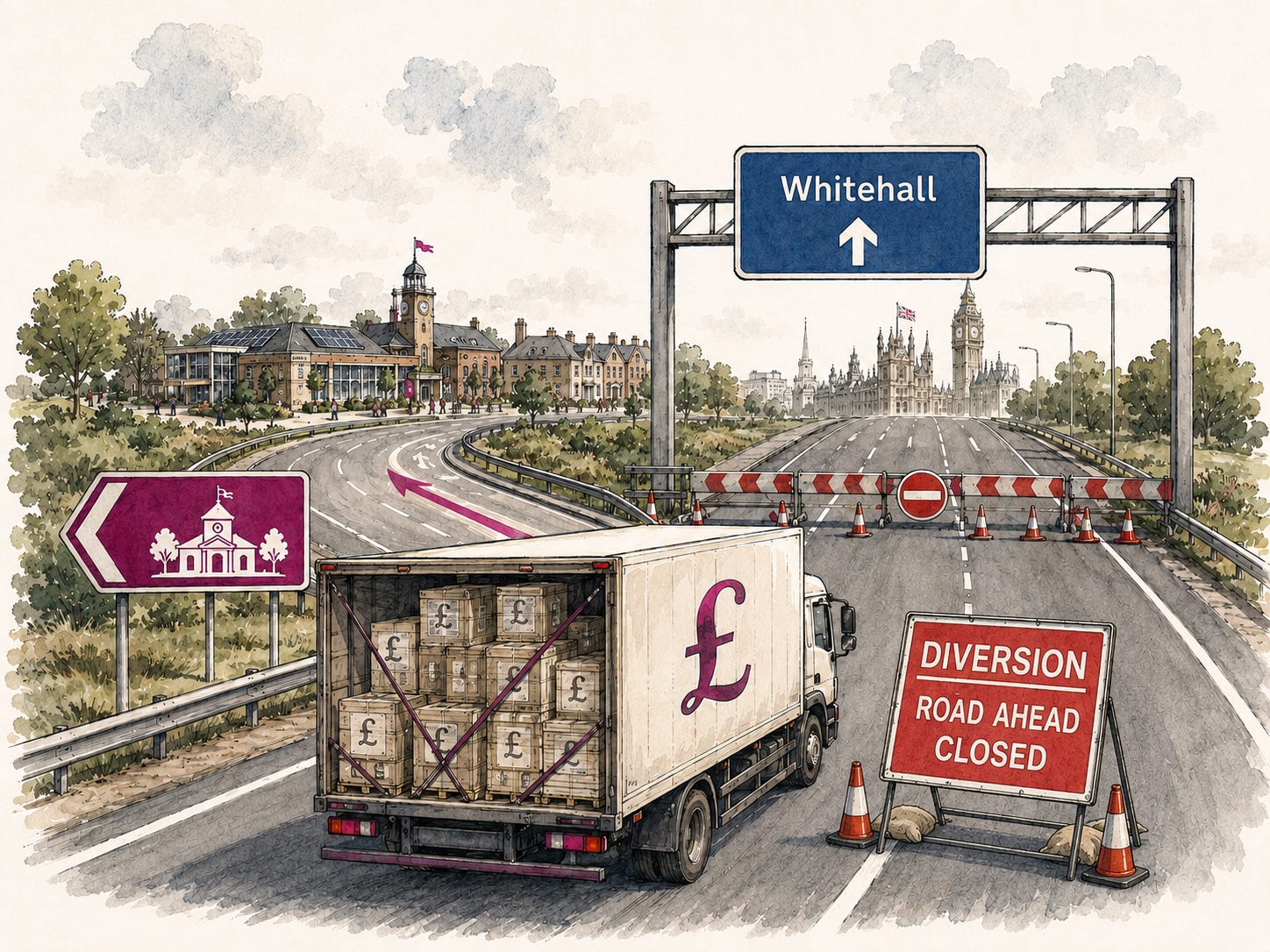
Today, Re:State publishes ‘Taxing for take-off’, a major new report setting out a blueprint for fiscal devolution in England.
Consider the following facts:
Leeds remains the largest city in Europe without a mass transit system, despite locally supported plans for a tram being put forward more than 30 years ago.
The London Borough of Tower Hamlets submitted 96 objections to plans for the Elizabeth line, with 15 other councils along its route also submitting multiple objections to the project.
The Treasury spent two years designing an “earn back” scheme so that Greater Manchester could benefit directly from local investment in infrastructure that led to economic growth, but found it so difficult to design that they abandoned the scheme in favour of another conditional grant.
The Government designed a mechanism to encourage councils to approve more housebuilding – the New Homes Bonus – before scrapping it last year, saying that it had proved to be “an ineffective incentive”, despite estimates that the UK has a shortage of 6.5 million homes compared to similar European countries.
The planned ‘Overnight Visitor Levy’, or tourist tax, would be the first new power for the local state to raise funds without central control since the 17th century.
Every six months, the West Midlands Combined Authority has to report back to officials in Whitehall on how many teaching days have been delivered by industry professionals within further education settings; the South Yorkshire Combined Authority has to say how much additional floorspace it has unlocked within its Investment Zone; West Yorkshire must give data on what percentage of buses have departed no more than one minute early and no more than five minutes 59 seconds late; Greater Manchester has to update on its progress reducing the number of roads that should be considered for maintenance; Liverpool City Region must produce figures for how many journeys have been made on its tram; and the North East has to give the percentage of its bus fleet that is zero tailpipe emission.
What is the common thread here? They are all the product not just of centralisation, but of fiscal centralisation. In the UK, central government raises more than 90 per cent of all tax revenues, compared to an OECD average of 53.2 per cent. We are at the bottom of the G7 for the share of national taxes collected at subnational level. England remains not only highly centralised, but in fiscal terms one of the most centralised countries in the developed world.
Why does this matter? Because when a place does well economically, hardly any of the resulting tax revenue is retained locally – it pretty much all flows back to the Exchequer to decide how to spend. This means that local and regional authorities have almost no stake in decisions that might be disruptive, but which are ultimately good for growth.
It’s why some London boroughs were happy to slow down Crossrail – there was little financial hit to them as a result. And it’s why despite the Greater Manchester Combined Authority presiding over some of the fastest growth in the country in recent years, it still has to tick boxes for the Department for Transport on bus journeys – and remains almost entirely reliant on funding from Whitehall for its regional government to exist.
It’s also why the Government designs (or attempts to design) complex schemes like “earn back” and the New Homes Bonus to encourage local investment and housebuilding – which highlight both that existing incentives aren’t strong enough, and that technical fixes without broader system change won’t work.
And it lies at the heart of the long-running saga of the Leeds tram. Why can’t Leeds get on and build the tram despite local support? Because neither Leeds City Council nor the West Yorkshire Combined Authority (responsible for the economic strategy of the wider city region) have a sufficient long-term, reliable revenue stream of their own they can use to self-finance it. So, they have to submit various business cases to Whitehall to convince officials of the scheme’s value for money and then get a “Transport and Works Act Order” from the Secretary of State. In a Spanish or French city this would not be a problem – the permission does not lie with central government, and the money is theirs to spend.
The current wave of devolution has been underpinned by a recognition that economic strategy is most effective when it is tailored to the strengths, conditions, and priorities of a particular place. But this means giving regional leaders the flexibility to do things their own way.
This flexibility is what integrated settlements were meant to secure, with the English Devolution White Paper claiming that “for the first time Mayors are not bound by strict Westminster rules over how to spend money locally.” Yet the lengthy list of highly specific targets the most ‘established’ mayoral authorities have to focus and report on tell a different story (see bullet point six above).
Integrated settlements are undoubtedly an improvement on the previous practice: a single pool with more ability to move funding between areas rather than a multitude of rigidly ring-fenced small pots. But they have not rewired the system.
In the UK, taxation has long been seen as Parliament’s business, with local government left to tinker with the ‘local rate’ and little else. Devolving meaningful tax powers cuts against centuries of constitutional instinct. This is why a properly locally controlled tourist tax would be such a departure. It was only relatively recently that the Scottish Parliament was devolved a more substantial set of fiscal powers, almost two decades after it was established.
But fiscal devolution – long the hobby horse of local government policy wonks – is now moving into the mainstream. The surprise centrepiece of Rachel Reeves’ Mais lecture earlier this year was the announcement of a fiscal devolution “roadmap”, to be unveiled at this year’s Budget.
This is a significant opportunity, and one that must not now be wasted on a half-baked approach that looks something like fiscal devolution, but which is actually a rebranded version of central government grant funding. This would be fiscal devolution in name only.
Why fiscal devolution in name only won’t work
Fiscal devolution can transform the relationship between national and subnational government in England. But for this to be the case, it must change the way money flows through the system. The current model involves funding moving from the Treasury to the various different Whitehall departments, and then if a spending programme is deemed to be in scope of devolution, to the Ministry of Housing, Communities and Local Government, and finally out to strategic authorities. This makes those departments ultimately responsible for how that money is being spent, which is why so many conditions and granular targets end up being attached.
There is one way of approaching fiscal devolution that would involve essentially relabelling central government grant funding and linking it to levels of regionally generated taxation. But this would leave the wider relationship unchanged, and central government departments would still feel obliged to micromanage to show good value for money on the spending to Parliament.
Unless this can be shifted, then the artificial silos that structure Whitehall will continue to be passed down to the regional and local level – limiting the potential for devolution to break down these barriers and operate instead in a truly place-based way.
This is why fiscal devolution must come from Parliament and go directly to devolved authorities. Rather than negotiating with, and accounting to, multiple different departments, the relationship should be a more direct – and less hierarchical – one between strategic authorities and the Treasury. Accountability should be first and foremost to the local electorate, but this should be coupled with enhanced local accountability and scrutiny bodies.
What full fat fiscal devolution should look like
Today, we’ve published our own blueprint for a ‘full fat’ version of fiscal devolution. We argue that while taking the path of least resistance might be tempting in the short term, a minimalist approach is not what England’s regions need. Instead, as a starting point, the most mature devolved authorities should be able to keep hold of 2.5p in the pound of basic-rate income tax paid by their residents. This would not mean new or higher taxes. Rather, it means regional authorities keeping hold of a portion of one of the major national taxes generated in the area and giving them meaningful flexibility to spend it in ways that reflect the local context.
Income tax is a buoyant source of revenue: it tends to go up when there is economic growth. When regional authorities build more homes, support the creation of more jobs, and improve transport connectivity this will be reflected in their revenues as the value of their retained income tax share would rise. The system we suggest would involve redistribution at the outset to ensure more equal starting points between places. But then they would get to keep the additional growth in those revenues over a six-year period – long enough to see successful investments and pro-growth policies start to pay off.
Mayoral authorities should also get to keep 100 per cent of business rates growth in their areas and have more discretion over the business rates system. Not only this, but they should have full control over the tourist tax when it arrives – both in terms of setting rates and spending the revenue it raises. This would create a basket of different reliable sources of revenue for mayoral strategic authorities and their constituent local authorities.
The emerging mayoral strategic tier now has a set of nine formal competences provided for in the recently passed English Devolution and Community Empowerment Act. But there is room for these institutions to take on more responsibility in these areas. In time, as the map of English devolution is filled in, this would allow for a more streamlined central state. At present their health, wellbeing and public service reform responsibilities remain vague – and in others, such as skills and employment support, the scope could be expanded.
The funding model we argue for would enable a movement away from a position in which the local state is simply the delivery agent for priorities and schemes formulated in London, and towards being the part of the State with primary policy responsibility in these areas, and more. This wouldn’t, however, mean a bigger State overall – because more money and responsibility in the regions should be matched by less money and responsibility in Whitehall.
Only the beginning…
Retaining more of the taxation being generated locally is an essential starting point for fiscal devolution. Designed well, it can change the dynamic of the relationship with the centre and strengthen the connection between policy and economic performance.
However, where we are now should not be the limit of ambition when it comes to a more decentralised England. That’s why we are working with a group of mayoral strategic authorities to shape the future of devolution policy through our Devo Next Initiative.
Longer-term, England needs a model where regions not only retain a portion of revenues but have more autonomy over the design of taxes too. In a world in which subnational government has a much greater role in essential public services such as health and education, the fiscal settlement must keep pace. Mature devolved authorities should have the discretion to tailor the tax mix to local and regional needs, and be able to use tax design as a policy lever.
Our report argues that the long-term goal for fiscal devolution should be giving regional leaders the power to vary rates and create new bands via a progressive regional income tax.
Wider property tax reform should also be on the agenda, with business rates, and potentially also council tax and stamp duty, replaced by a land value tax. Taxing the value of land would allow for the increase in value that comes from investment in infrastructure and other public improvements to be better captured locally, in turn helping to self-finance this kind of investment.
This new plan for fiscal devolution shows how we can end the ‘begging bowl’ culture – unleashing the growth potential of England’s regions, from which we all would benefit, as well as freeing up central government to focus on genuinely national priorities. The good news is that because England is so fiscally centralised, it can now jump forward. But only if we are prepared to take the leap.
Read ‘Taxing for take-off: a new plan for fiscal devolution’ here.
Here’s to a brighter future with fiscal devolution