
Quote of the Week:
“Integrity, impartiality, honesty and objectivity run through the stick of rock of the civil service, and rightly so, but would we not also want to have something about being curious and about curiosity? I think you can invest a lot in that. I am just flying a kite there for the moment.”
Cabinet Secretary Dame Antonia Romeo hinting at what new values might be included in her updated Civil Service Code before the Public Administration and Constitutional Affairs Committee.
I am aware that I am facing stiff competition for your attention this morning. Many people who keep an eye on public policy and politics today will be not unreasonably focussed on the result of yesterday’s Makerfield by-election. For more on that election head to our recommended read of the week at the bottom of this post.
In this newsletter we aim to look at policy developments that often fly under the radar. This week has provided us with ample opportunities to look at how the Government approaches technology policy. Social media, AI, and digital sovereignty have all been in the news for a host of reasons and have provided another opportunity to showcase that although the UK has an enviable set of advantages when it comes to AI and technology more broadly (e.g. excellent higher education institutions, a respected financial sector, rule of law, etc.) it faces long-term technological challenges that could, if left unaddressed, hamper the innovation the Government should embrace.
On Monday, the Prime Minister announced that the Government will ban social media for under-16s by next spring. The ban will go further than that imposed in Australia, with DSIT Secretary of State Liz Kendall calling the ban “Australia plus plus”. According to the Government affect social media sites could use facial recognition, digital IDs, credit card checks, or passport scans could be used to enforce the ban, which will be the most restrictive online speech policy seen in a liberal democracy.
It is not a tech-friendly policy but is consistent with the Government’s approach to large predominantly California-based companies. Civil liberties groups have warned that the approach will put the privacy and security of law-abiding adults at risk as they are required to prove that they’re not children by sharing personal information with a range of websites. It is also possible that the Government will seek to hamper access to Virtual Private Networks as adults and children alike seek to avoid identity and age verification requirements.
The ban also poses a threat to the ability of curious children to satisfy their curiosities and to easily access valuable tools and resources. No doubt there are harms associated with social media, but a ban represents a blunt approach to a nuanced problem.
Speaking of blunt approaches, last week the US Government issued an export control banning non-US citizens from using Anthropic’s Fable 5 and Mythos 5 models. Anthropic has cut of all users from the models as a result. The Government has denied that it sought a carve out from the move, but the restriction on the models raises important questions about the UK’s digital sovereignty. If millions of British researchers, students, business owners, and government officials are using American foundation models what should the Government do if the US Government can strip access to them with the issuing of an export control?
As Carnegie Endowment Fellow Anton Leicht explained in his latest Substack post, the UK just does not have the economic, infrastructure, or technological means to build and host its own foundation models. There is a chance that concerns about AI sovereignty will result in middle power countries building new institutions or forming new arrangements to address the sovereignty issue. If you are interested in what such institutions and arrangements could look like I recommend reading Leicht’s post.
Given the fast-moving nature of AI developments, it is not a surprise that Cabinet Secretary Dame Antonia Romeo mentioned the Government’s use of AI many times in her Monday appearance before the Public Administration and Constitution Committee. As I noted in this week’s Re:Act post on Romeo’s comments, how Romeo can ensure that an institution as culturally risk averse as the Civil Service can be equipped with the necessary AI toolkit and knowledge to improve the state of public services remains to be seen.
Read of the week
Andy Burnham, the new MP for Makerfield, finds himself in the eye of the Labour Party’s seemingly self-perpetuating leadership storm. There will be plenty of coverage of Burnham’s career and national policy agenda in the coming days, but I urge you not to neglect coverage and analysis of his time as mayor of Greater Manchester. I found Charlie Cooper’s article on “Manchesterism” in Politico to be an interesting overview of Burnham’s beliefs and a helpful, somewhat sceptical glimpse into how he might approach localism and devolution if he ever walks through Number 10 as prime minister.
Have a great weekend.
Matthew
Research Manager

On Monday, our Alternative People Survey 2026 was launched. The survey was created to give civil servants a direct, anonymous voice on issues affecting their work. Last year's results revealed some striking insights, and this year's survey explores how attitudes are changing. The launch was covered by Civil Service World.
Also on Monday, our Re:Imagining Health workstream published Unlocking potential: the intersection of women’s health and economic outcomes. This write-up drew upon our panel with Dr Amanda Doyle OBE, Dr Sue Mann and Baroness Geeta Nargund, with thanks to AbbVie who kindly provided funding to make this event and write-up possible. AbbVie had one representative on the panel, but the topics and all other panellists were chosen by Re:State.
On Tuesday, we welcomed Helen Whately MP, Shadow Secretary of State for Work and Pensions to deliver a keynote speech, announcing a landmark review of sickness and disability benefits. She was joined by The Rt Hon Sir Jeremy Hunt MP. The event can be watched here. The speech was covered by The Times.
Also on Tuesday, Research Manager, Matthew Feeney, wrote a Re:Act snap analysis entitled ‘The Cabinet Secretary’s Civil Service vision’ discussing Dame Antonia Romeo’s ambitious Civil Service reform agenda.
On Wednesday, Researcher, Alice Semark, spoke on a panel entitled ‘Developing an NHS Fit for the Future’, hosted by the University of Nottingham as part of their Policy Impact Day.
Also on Wednesday, Director of Impact, Joe Hill, published a Substack entitled ‘Launching the Alternative People Survey 2026’.
On Thursday, our Re:Imagining the Local State team published Taxing for take-off: a new plan for fiscal devolution. The report launch was covered by Room151, quoting Senior Researcher Alex Walker.
Also on Thursday, Alex published a Substack entitled ‘The fiscal devolution theory of everything’, accompanying the report launch.

This week, our Re:Imagining the Local State workstream published Taxing for take-off: a new plan for fiscal devolution, arguing that England’s highly centralised tax system is undermining the promise of devolution. While strategic authorities are taking on greater responsibilities for transport, housing, skills and growth, they remain heavily dependent on funding from Whitehall, limiting local accountability and flexibility.
The report makes the case for giving local leaders greater control over spending and a stronger financial stake in the success of their local economies. It argues that meaningful devolution must be backed by real fiscal powers, alongside robust accountability and fair funding arrangements that support areas with weaker starting positions.

Calling all civil servants: tell us what you think. The Alternative People Survey 2026 is now live.
The Survey, launched in partnership with Civil Service World and Public First, aims to capture the views of civil servants working in Whitehall on the most important questions affecting their work. The survey is completely anonymous, and takes 5-10 minutes to complete.
Fill in the survey here, and read more about it here.

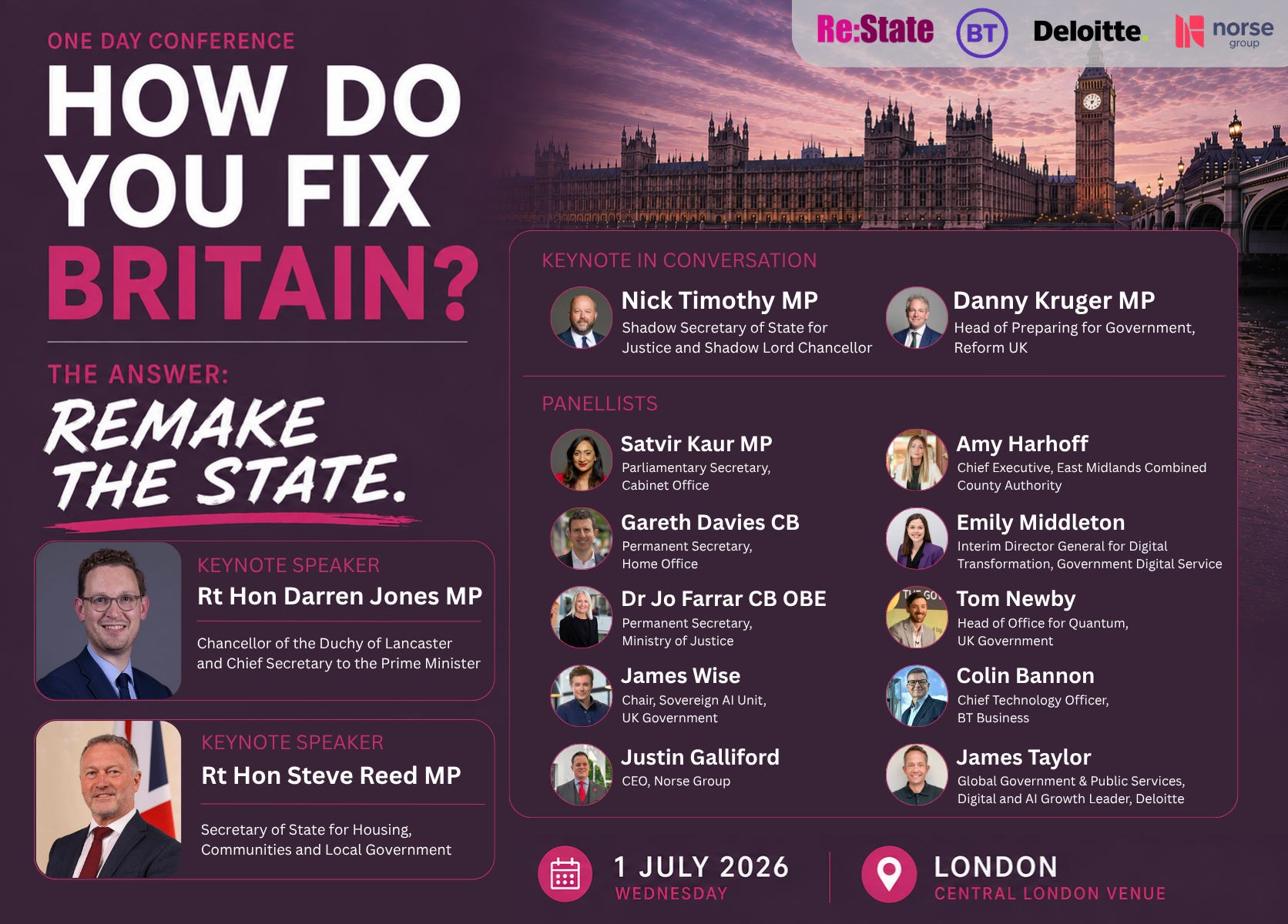
On the 1st of July, we are hosting our flagship annual conference ‘Remaking the State’. We are delighted to welcome the Rt Hon Darren Jones MP, Chancellor of the Duchy of Lancaster and Chief Secretary to the Prime Minister and The Rt Hon Steve Reed MP, Secretary of State for Housing, Communities and Local Government to deliver keynote speeches, alongside an incredible line-up of speakers.