

Why we need metapolicy
What the state capacity field can learn from metascience

A few weeks ago The Telegraph ran a strange story about civil servants getting paid to play Grand Theft Auto as part of a drive to try and encourage more creative approaches to policymaking. It got the usual eye rolls from commentators and then everyone moved on, but it points to something more fundamental. It underscores just how weird policymaking has become in Westminster, and it’s far from the only example.
Consider how:
· Keir Starmer called the fictional Netflix drama Adolescence a “documentary” in Parliament, then did so again at a roundtable weeks later. His Government went on to back Netflix’s plan to stream the drama for free in every secondary school in the country.
· ONS price statistics had to be suspended in 2025 when officials found a calculation error that had sat undetected in a legacy system since 2020 – meaning five years of headline inflation-adjacent data had been wrong. Concerns about the quality of the Labour Force Survey have drawn criticism from independent economists, the Treasury Select Committee, and the Governor of the Bank of England – and a replacement survey will not be ready until 2027.
· Natural England had to revoke guidance it issued which would have led to farmers on Dartmoor culling up to 93 per cent of the Dartmoor ponies, which have lived wild on the moorland for more than 3,500 years, in the name of preserving the local environment.
· within days of the ITV drama Mr Bates vs The Post Office airing, the Government announced it would fast-track legislation to overturn hundreds of criminal convictions of postmasters, based on the TV show’s popularity rather than the outcome of the seven-year public inquiry into the same scandal.
· every year, the OBR forecast assumes that fuel duty will rise with inflation, something that hasn’t happened in 17 straight years, making it an assumption which the Treasury Select Committee has called a “fiction”. Yet it remains a part of the baseline assumption used by every government to set its fiscal forecasts.
· the HS2 £100 million “bat tunnel” and Hinkley Point C’s “fish disco” are now notorious examples of the lengths that environmental quangos require infrastructure bodies to go to, despite minimal evidence of the effectiveness of these measures and the huge costs involved in meeting them.
These aren’t isolated examples. Together they show that something at the heart of the institutions which make policy in Britain has gone badly wrong. To address this failure in policymaking, we need a better understanding of how good and bad policies are made, and how to build institutions which make better policy in the long run – in other words, ‘better policy about how to make policy’. But there isn’t yet a field which adequately answers that question – some fields hold kernels of the answer, but nowhere is there one place which brings those kernels together.
We need a new discipline for answering these questions: ‘metapolicy’.
A history of metapolicy
There are plenty of historic efforts to improve policymaking which metapolicy can learn from.
Some reformers have focused on improving methods and evidence-gathering. In 1894, the Fabian socialist Sidney Webb was named executor for the estate of Henry Hutchinson, who had left the Fabian Society a substantial legacy of nearly £10,000 (about £1.1 million in today’s prices). Rather than spend it on the Society’s usual work, Webb proposed using it to found a new institution dedicated to “the study and investigation of the concrete facts of industrial life and the actual working of economic and political relations as they exist or have existed.” He and three co-founders named it the London School of Economics and Political Science, which opened its doors in 1895 and has been a home of economic and policy research for many decades.
Other reformers focused on building outside institutions to improve policy research in the long term. Webb was one of a number of late-Victorian and Edwardian reformers who believed that the State’s ability to design effective policy could be improved by empirical methods, rather than relying on ideology and guesswork. These reformers looked to new methods of social science for answers, like the door-to-door poverty surveys that Charles Booth conducted across London from 1886. Booth set out to debunk a claim by the Social Democratic Federation that a quarter of Londoners lived in extreme poverty, believing it “grossly overstated”. But his own data instead confirmed it, finding the true figure closer to a third.
The core idea that policymaking institutions could be improved by greater rigour comes up time and time again, and cuts across the political spectrum. In 1971, Edward Heath created the Central Policy Review Staff, nicknamed “the Think Tank”, as a small unit inside the Cabinet Office designed to give ministers long-term, cross-cutting strategic analysis that individual departments were unable to produce on their own. Heath appointed Victor Rothschild as its head, a Cambridge zoologist and head of research at Shell, and who despite running “the Think Tank” for a Conservative PM sat in the House of Lords as a Labour peer.
In other cases, policymakers have sought to apply methods from outside of the public sector to government problems. Former software entrepreneur John Hoskyns and Unilever business executive Norman Strauss were the authors of the 1977 “Stepping Stones” report on how Margaret Thatcher’s Conservative Party should make the case and make the policy to restructure the British State, accompanied by the famous ‘wiring diagram’ which borrowed methods from systems analysis to try and trace the roots of Britain’s economic decline.
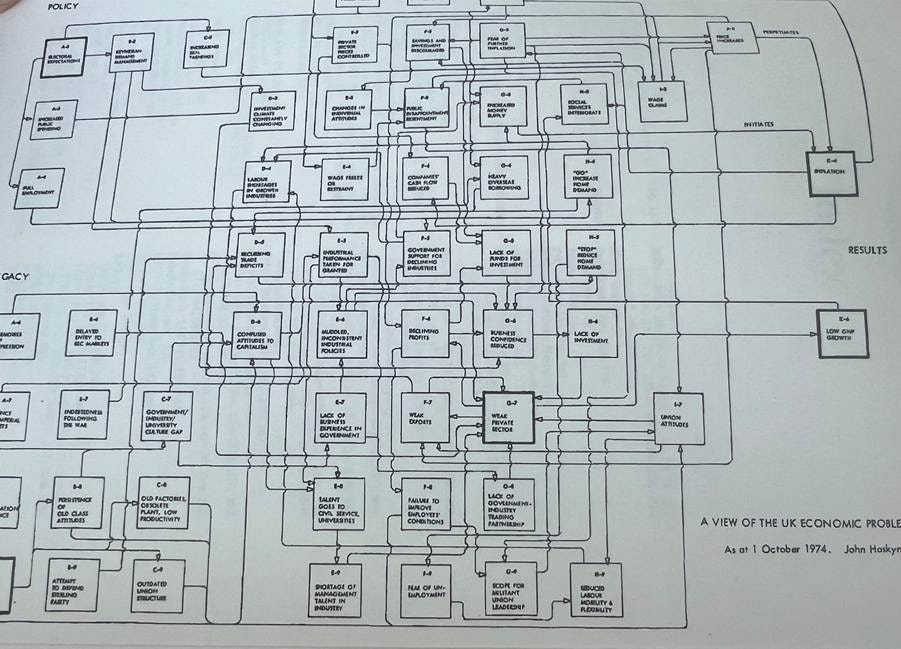
A view of the UK economic problem, 1977 (aka ‘the wiring diagram’).
Source: Just in Time, by John Hoskyns
A focus on reforming institutions isn’t unique to Britain. The Office for Budget Responsibility in the UK was directly inspired by the Congressional Budget Office founded in the US in 1975 to provide independent financial analysis to legislators, and the RAND Corporation established in 1948 created the model for many modern think tanks. The French École nationale d’administration (as well as its successor, the Institut national du service public), and the Singaporean Administrative Service both have longstanding structures and processes for educating policymakers in the disciplines they need for their work. New Zealand’s Treasury in the early 1980s closely studied the market liberalisations which Margaret Thatcher’s Britain was undertaking, and presented the incoming Labour Government with a briefing document called Economic Management (which ran to over 300 pages) laying out a blueprint for a similar programme.
Where policymaking went wrong
When researchers talk about degraded state capacity in the UK, they rarely mean government’s core policymaking competence. Usually, the deficit is most discussed in areas like scientific and technological capability (e.g. AI safety or pandemic science), legal straitjackets (judicial review, procurement, regulation) or workforce and talent issues. Often it’s accepted as a given that our ‘Rolls-Royce’ Civil Service is still good at serving ministers at its core job – developing policy ideas – even if the delivery is often considered bad.
But this is false, and it has let the institutions of the State off the hook in important ways.
Our policymaking class (mostly, but not entirely, in the Civil Service) has been slowly giving up its responsibility as a professional institution, and in many cases the “policy profession” has become a kind of client function for political crisis management, stakeholder liaison and serving the never-ending demand for government ‘comms’.
Rather than spending time on creative or analytical exercises, civil service policy teams report spending most of their time fielding queries for briefings and ‘lines to take’ on issues in their portfolio, dealing with Parliamentary questions and FOI requests, having a lot of internal meetings to coordinate the department’s messages, and arguing over the minutiae of wording in any policy advice that goes to ministers.
This last point is almost impossible to overstate – speaking from personal experience, most civil service written advice is a jumble of different individual opinions from many drafters, and rarely reflects one person’s considered position. As a result, the advice is often garbled and makes little sense – in trying to represent the lowest common denominator of policy ideas across a big group, it can be much worse than if it expressed the views of any one individual.
Conscientiousness, and avoiding disagreement at all costs, often mean that difficult trade-offs are avoided. A common phrase in Whitehall is ‘finding a form of words’ to get around a tricky issue, rather than discussing it in the kind of detail that may be uncomfortable but would make it easier to arrive at the right solution.
Ministers also spend much less time on what Re:State calls ‘policy engineering’ than senior leaders in other organisations. They mostly spend their time on visits, meetings with other ministers, getting updates on legislation, and doing press and communications work. They make most policy decisions based on written correspondence in their ‘box’, often worked on late at night, and based on the poor briefings described above. They have high turnover, making getting involved in any projects which take longer than a year unappealing to any given minister – because policymaking has become so slow that they never get to see it through, and so many issues fester away for years unresolved.
In practice this means policymakers and the systems they operate in cannot consistently develop, agree and announce substantive policy changes at all – to say nothing of the problems they have delivering them. When they do manage to see this process through, it is mostly in very specific and suboptimal circumstances. The dysfunction of the system is obvious when we break down the three ways policymakers actually ‘make’ new policy: in a crisis, through a strategy, or through a ‘fiscal event’. Taking those in turn:
1. Crisis.
Ministers often have to make big decisions quickly in a crisis. Often they do this badly. In a crisis where there’s been a disaster and there are victims, often bad policy is made because it’s quickest and easiest to announce, and good policy would take longer. ‘Something must be done’ is usually the gateway to bad policy, like the building safety rules brought in since Grenfell which have all but halted construction of residential homes in London, or overbearing nuclear safety policies in most Western countries following the Chernobyl disaster. Crisis is a bad way to make policy in most cases, even if sometimes political entrepreneurs are successful at using crises to further their individual aims.
2. Strategies.
Governments are constantly churning out ‘strategy’ documents (Green Papers, White Papers, Command Papers, and other formal government publications stating their policy intent). Despite the name these usually turn out to be anything but strategic. In their first year the current Labour Government published their Plan for Change, an Industrial Strategy, an Infrastructure Strategy, an Investment Strategy, a Child Poverty Strategy, a Strategic Defence Review, and a 10 Year Health Plan for England (to name just a few). Think tanks and other commentators have a big incentive to encourage strategies, because the Government usually announces that they’re doing one in advance, and gives those commentators time to push for the policies they want to be included (and claim the credit when they are).
But think tanks aren’t the only ones doing that – any government announcing a strategy or review is firing a starting gun for all the ‘stakeholders’ and vested interests to pile into the department with their asks and their red lines.
Most officials don’t know how to really solve policy problems, their engagement with the outside world is highly controlled (which prevents them finding out much new information), and bureaucratic structures make it very hard for strategies to ever deal with uncomfortable trade-offs. In practice, that means strategy documents become entirely anchored on what stakeholders do and don’t want, because policymakers don’t have other models for how to write a strategy. This becomes a problem in most cases, because the sum total of asks from vested interests is usually the wrong answer – particularly when the current policy is bad, current budgets are not allocated well, or the area is dominated by bad policy memes and saying any of these can become a surefire way to rile up the stakeholders.
The only way officials are ever allowed to write these strategies is through endless meetings, cross-departmental revisions and slide decks usually made up of colourful text boxes and discussions of ‘principles’. Good thinking can’t be done by consensus, so Whitehall’s preference for internal and external consensus prevents it from thinking creatively, and from thinking honestly about hard trade-offs.
In practice, this means what usually happens is something like this:
a. Ministers commit to publishing a big strategy to show they’re trying to do something about a real problem.
b. Stakeholders have lots of opportunistic asks from the strategy.
c. The Government has usually ruled out a bunch of good ideas before they even start, and civil servants can’t seek out new information or create new ideas very easily without annoying stakeholders.
d. So the strategy document which ministers end up with doesn’t say much which is new, and its publication looks like it’ll be underwhelming, but they promised they would publish one so now they have to publish one.
e. Unless… their one hope is if the Treasury gives them extra money to announce they’ll spend in the strategy, to help square the circle of “do more without annoying anyone”. But the Treasury very rarely does this – indeed, you can see from the recent squabbles over the Defence Investment Plan how vigorously they will oppose this approach.
f. Often this is how strategies drive the problem of Everythingism which I wrote about last year: repurposing other policies slightly to make them advance your own policy has a low social cost in Whitehall, and the Treasury is usually relaxed about it compared to spending more money, even if it’s nearly always the wrong way to fix the problem (and may actually make the objective behind the other policy, the one you are trying to piggyback on, harder to achieve).
g. Because every Strategy becomes a bid to spend more money, and the Treasury doesn’t like to get picked off one at a time, it usually shuts down those discussions and says it will only do money ‘in the round’ – usually at a fiscal event (a Budget or Spending Review) and after the strategy is published. For what it’s worth, this is sensible – governments shouldn’t spend money without knowing how they’ll pay for it (see the next section).
h. So the published strategy doesn’t please anyone, but the Government has to do it because it said it would.
3. Fiscal events.
In practice, huge amounts of policy is announced at ‘fiscal events’ – Budgets and Spending Reviews. These processes are controlled by the Treasury, and because they’re about adding up short-term sums that tends to make all policy about the distribution of the relatively small amounts of flexible money in the public finances – the ‘headroom’ and the Reserve.
This means HMT focuses on policy which helps it add up the sums in the next few years, and underweights more long-term or non-fiscal policy. They’re also quite simplistic in the policies they choose to deliver, particularly when it’s outside of the Treasury’s core competence – while HMT has small teams covering most policy areas, they don’t have the firepower to micromanage public budgets, and departments rarely want to play ball. Big policy changes, like moving social care to a prefunded model, fiscal devolution, or procurement reform are all hard for HMT to fit to the six-monthly drumbeat of fiscal events – so they always get pushed back into the ‘we’ll do it next time’ bucket, and ‘next time’ never arrives.
How metascience is solving the replication crisis in science
In a parallel to how crises in scientific research have led to a ‘metascience’ movement focused on improving the institutions of science, crises in policymaking should force us to reexamine the set of institutions and systems we use to make policy.
For over a decade science has been plagued by awareness of a growing replication crisis: the inability to prove that the findings of many studies hold up consistently. The Reproducibility Project attempted to replicate 100 published psychology studies in 2015 and succeeded in doing so with only a third. The Center for Open Science (set up in 2013), Stuart Buck’s work at the Laura and John Arnold Foundation, and John Ioannidis’ work at Stanford to study research practices all created a groundswell of interest in how to redesign scientific practices and institutions to make them more reliable. The first Metascience conference brought many of these together in 2019, the same year that Patrick Collison and Tyler Cowen published their essay We Need a New Science of Progress in The Atlantic. Cowen and Collison outlined a model which they began to prove with their Fast Grants experiment in the Covid-19 pandemic which awarded research grants in 48 hours compared to the months that the National Institutes of Health (NIH) took.
Across the world and in the UK, metascience is beginning to see big changes, and not just driven from within the field of science. The Advanced Research and Invention Agency (ARIA) is an attempt to replicate more ‘moonshot’ methods in the UK’s R&D ecosystem. The Department for Science, Innovation and Technology launched a Metascience Unit in 2023 to fund new experiments in public R&D. The NIH and the White House have both launched reproducibility initiatives. Organisations like Convergent Research in the US and Science Works in the UK exist to support and incubate a new generation of scientific institutions.
A new theory of ‘metapolicy’
Just like the failures of the scientific community have catalysed the metascience movement, the failures of the policymaking community demand study of ‘metapolicy’. In Westminster, this is seen as very ‘back office’, but it’s increasingly existential for policy institutions.
There are clearly better ways to make policy, and some of the common characteristics of it are obvious. Combining deep expertise with ‘blue sky’ thinking, bringing in advisers from outside traditional policymaking backgrounds and people who aren’t captured by the ideologies which dominate particular policy areas. Questioning fundamentals, learning deep history, finding new data, and building better ‘models’ of the problem that then help solve it. Building coalitions for policy change, and thinking about how you can ‘buy off’ or compromise with the losers without conceding the whole policy (which is a more common outcome). Ignoring both the short-term ‘crisis’ and fake long-termist ‘strategy’ approaches in favour of a kind of medium-term project management of new policies from invention to execution.
But this is an incomplete list of principles, and also a complex set to apply in practice. They need to be built out, by the broad group of researchers and institutions who think about the components of metapolicy. But what we’ve lacked, and what Anne Healy so persuasively describes, is a ‘field’, and metapolicy is that field.
Since Max Weber, the research literature on ‘how bureaucracies work’ (and when they don’t) has barely evolved. Many fields of study can and should play a role in metapolicy, including: traditional public policy research, economics, business administration, political economy, mechanism design, more qualitative techniques for understanding organisations from fields like anthropology, and the breadth of the quantitative social sciences. Detailed case study research would play a vital role, like those in the longform interviews that Santi Ruiz collects through his Statecraft Substack and podcast.
Metapolicy thinkers shouldn’t just organise around disciplines, they should also organise around principles. The lack of progress for many would-be metapolicy concepts in recent years has stemmed from a failure to live up to four standards which seem core to success. The field should be:
1. Empirical, as all disciplines are, and not substitute bad models and ideas about public policy for the way public policy actually works and the context it has to operate in. It should encourage thinkers to develop good models of these processes, without becoming ideological or dogmatic about them.
2. Applied. Much policy research is far from the concerns of policymakers, or of those who design policymaking institutions. Metapolicy should be an applied science rooted in changing and improving policymaking.
3. Institutional. Public policy researchers tend to study incentives at individual and national scales, and neglect the key middle layer – the way that policymaking institutions work, and how to improve them.
4. Reflective. Lots of researchers, thinkers and commentators publish widely about policymaking, and many practitioners have deep views on the best way to do their jobs. As a rule of thumb, it’s an area where most parties have been insufficiently reflective – both on their own ideas, and whether they are right in the face of new data, and on each other’s ideas and whether there is enough constructive disagreement about the right approach. Insufficient internal debate within the field has undermined its quality, producing bad policy memes which don’t stand up to testing and scrutiny. Many ideas about how to make better policy have become important social signifiers in the policymaking community – reciting them by rote allows policymakers to signal their knowledge of good practice without really testing whether they work. Decades of consensus around the importance of ‘joined-up thinking’ and ‘breaking down siloes’ in government have left those ideas to be distorted into making bad policy – which we challenged head on in our essay on Everythingism last year.
One key debate for metapolicy thinkers is whether policymaking institutions can be reformed, or whether better practice needs new institutions to be set up instead. In the private sector successful corporate turnarounds are incredibly rare and much studied – Apple between 1997 and 2001, IBM under Gerstner, and a handful of other famous examples. But in the public sector we assume they are the default, and that the pain of creating new ones to replace old ones wouldn’t be worth the performance improvement in the long run. This seems unlikely to be true, at least in all cases. Equally, the public sector is littered with the husks of failed ‘new’ institutions set up to be innovative – particularly ones which couldn’t work through or around existing institutions, and where setting up a new team or quango has often become an excuse to avoid doing hard policy work in Westminster.
Another key debate is whether good policy requires a new settlement for the question of who ‘does policymaking’. The UK is unusual in how overwhelmingly reliant the country is on professional policymakers in the Civil Service. More devolution is pushing more policy decisions to regional and local government, but their policymaking operations are still small or in their infancy. Ministers appoint hardly any political advisers (far fewer than any other comparable country), and political parties have very little in the way of an internal policy staff. Private companies can bring huge resources to bear on policy issues, but rarely do so in consistent ways – usually preferring to stay out of policy debates for fear of political blowback, or taking part only as vested interests who want to perpetuate the status quo. The think tank sector is pretty small, but could achieve much more with the resources it has if it used them better. One can imagine lots of different balances of ‘who makes policy’ which involve the Civil Service doing less, and other groups doing more.
Public policy is still one of the highest-leverage tools in the world. Because of the scale on which modern governments work, small changes can make huge differences to the public. It’s an appealing prospect for those of us who work in it, but also a warning – the responsibility for making the right changes, and not making the wrong ones, is very real. The field of metapolicy will help a new generation of policymakers create the systems which live up to that responsibility.
> The Telegraph ran a strange story about civil servants getting paid to play Grand Theft Auto as part of a drive to try and encourage more creative approaches to policymaking.
As I read the story, it was about an experiment using GTA, which is a game in which many online participants interact, as a way of reaching and consulting with members of the public who would not otherwise normally engage with government consultations, run by the Policy Lab, a government unit whose remit is to experiment with new ways of formulating policies -- which seems to be exactly what this article is calling for.